An official program of the Emerging Technologies Laboratory
ETL
OPSEC Gauntlet

OPSEC Gauntlet.

Diagnostic Critique Engine · Radical Honesty · Uncompromising Rigor

The Problem This Solves

Two kinds of people never get anywhere with an idea.

The first kind comes to the table with an idea but no solution. They have identified something. They have not thought through what to do about it. An idea without a path is just a thought you carry around.

The second kind is worse. They have the idea. They have a solution. They have been thinking about it for months, maybe years. But they have no idea what to do next. They have never been told whether it holds up. They have never faced a room that will tell them the truth. They are ready to move and they do not know where.

OPSEC Gauntlet was built for both.

The idea without a solution gets a prep team. The idea with a solution gets a panel. Both get a routing report that tells them exactly where to go next. Not a verdict. Not a grade. A map.

Most people take their idea to a friend who tells them it is great. Or they drop it into an AI tool that tells them what they want to hear. Or they pitch it to someone who is too polite, too distracted, or too invested in their own agenda to tell them the truth.

None of that helps you. It just delays the moment you find out.

OPSEC Gauntlet tells you now.

How It Works

You submit. The panel evaluates. The math decides.

You submit your idea. A panel of sixteen sector chiefs evaluates it across five stages, one aligned to each CISA Critical Infrastructure Sector. Each brings a distinct sector, a distinct risk model, and a distinct retrieval system that pulls current real-world information before they say a single word about your submission.

Then the math runs.

The judges do not vote. They do not negotiate. They do not average their feelings. A triangulation engine calculates agreement, conflict, and coverage gaps across eight evaluation dimensions. A risk tier formula flags exposure. An evidence assessment identifies what you can prove and what you cannot.

The result is a routing report. Not a verdict. Not a grade. A map that tells you exactly where your idea stands and exactly where it needs to go next.

The Architecture

The math removes bias.

Every judge on this panel has an opinion. That is the point.

Selene will clock your AI tells. Marcus will ask who the exit is for before he asks what the product does. Grace will find the dual-use exposure you did not know existed. Raymond will want to know if you have actually talked to a customer. Priya will ask why you built this. Not what it does. Why.

But none of their opinions determine your score.

The scoring is math. Cosine similarity. Triangulation spreads. Risk tier formulas. The judges retrieve current domain information and structure their findings. The math produces the verdict.

What they think of you personally is irrelevant. What your idea actually is, is everything.

Bias lives in perception. We took perception out of the equation.

OPSEC Gauntlet does not care if you are likable. It cares if your idea holds up.

The Difference

This is not ChatGPT.

When you ask an AI tool for feedback on your idea it tells you what the average of everything it has read thinks about ideas like yours. It is trained to be helpful. Helpful means encouraging. Encouraging means it will find the angle that makes your idea sound promising even when it is not.

That is not feedback. That is a mirror that only shows you the good side.

OPSEC Gauntlet judges are current. They retrieve real data before they evaluate. Selene is not working from training data about AI startups. She is working from what is actually happening in AI right now. Marcus is not estimating market comps. He is pulling them.

And then the math runs. No personality bias. No sycophancy. No telling you what you want to hear because the algorithm learned that positive responses get better engagement.

Just the truth about your idea, delivered by people who know their domain and scored by a system that does not have feelings about your feelings.

After the Report

What happens after.

OPSEC Gauntlet does not end with the report.

If your idea is strong it moves forward. The routing report tells you exactly where to take it next.

If your idea has gaps the report tells you exactly what they are and sends you to the right specialist to address them. Come back when you have done the work. The judges will still be here.

If the core concept needs rethinking the report tells you that honestly and specifically. Not cruelly. Not vaguely. With enough precision that you know exactly what to fix.

Every run is a coaching note. Every return submission is progress made visible.

The platform tracks your history. You can see how your thinking has evolved across submissions. You can see where you started and where you are now. That trajectory is yours.

The Prep Track

You do not have to face the judges unprepared.

Before you reach the panel, eleven Operational Specialists hold offices along the corridor. Each one works your concept from a single discipline. They are not there to tell you it is good. They are there to find what a sector chief would find, while you can still do something about it.

Iris S. King meets you at intake, at the Office of Frontline Communications. Ms. Ivy takes the first substantive pass at the Office of Concept Integrity, establishing whether the concept is new and whether the claims holding it up are supported. Dr. Sahini Rao follows at Dual Use Systems Analysis, mapping where a civilian concept carries military or hostile application.

The corridor offices run from there: Structure and Compliance, Legal Surface Review, Human Factors and Insider Risk, Financial Exposure, Risk Discipline and Guardrails, Information Exposure and Discoverability, and Visual Surface and Brand Security. Dr. Ali Malik holds the last desk, Threat Attribution and Subject Analysis, running your concept the way an outside analyst would — because eventually one will.

The corridor is optional. If you believe the concept is ready, go straight to the Chamber. But the offices exist because most concepts do not survive the panel intact, and the corridor is where that gets fixed.

The Panel

Sixteen sector chiefs. Sixteen CISA sectors. One room.

Dr. Helena Ward
Chemical
Col. Rafael “Rafe” Dominguez (Ret.)
Defense Industrial Base
Dr. Liyun Zhao
Communications
Miles Harrington
Financial Services
Dr. Amina Farouk
Healthcare & Public Health
Jonas McCrae
Emergency Services
Dr. Priyanka “Pri” Nanduri
Energy
Elias “Eli” Kade
Water & Wastewater Systems
Dr. Mirela Stanescu
Transportation Systems
Gunnar Thorsen
Critical Manufacturing
Dr. Lynn Whitlow
Food & Agriculture
Victor Hale
Government Facilities
Dr. Yara Ben-Saïd
Nuclear Reactors, Materials & Waste
Owen Kessler
Information Technology
Dr. Marisol Quintero
Dams
Soren Veldt
Commercial Facilities

Three are assigned to your concept. The platform recommends based on your submission. The final pick is yours.

The Price

What it costs.

The Gap-Finder
$19
The entry point. A structured gap screen against the existing record before you invest another month.
The Full Walk
$199
The entire corridor, every specialist office, and all sixteen sector chiefs. Consolidated findings.

Corridor offices $39 · Standalone Consults $249 · The OPSEC Pass $39/month

The Standard

One belief.

This platform was built on one belief.

Most ideas do not fail because they are bad. They fail because nobody told the person behind them the truth early enough to do something about it.

OPSEC Gauntlet tells you early. It tells you specifically. It tells you without softening the finding or burying the lead.

And then it tells you where to go next.

That is the standard. That is what you are paying for. Not validation. Not encouragement. Not the comfortable version of the truth.

The real one.

OPSEC Gauntlet. Where ideas get tested.


The Person Behind It
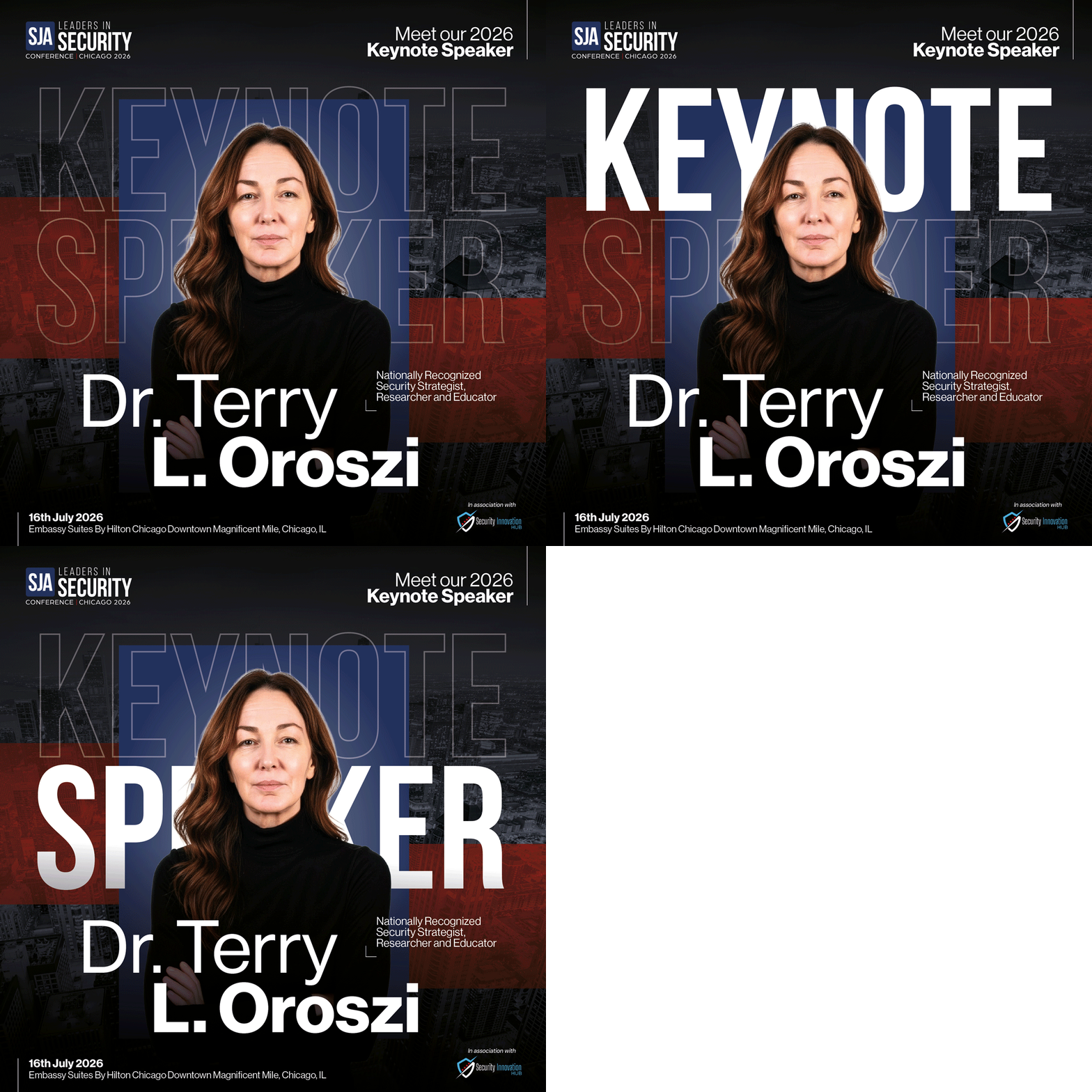
Dr. Terry L. Oroszi
Dr. Terry L. Oroszi
Full Professor, Wright State University Boonshoft School of Medicine
Vice Chair, Pharmacology and Toxicology
Forbes Technology Council
Army Veteran · NBC Specialist
FBI Joint Terrorism Task Force Executive Committee
Harvard Kennedy School Alumni

Most platforms that claim to evaluate ideas were built by people who have never had to evaluate anything with real consequences.

This one was not.

Dr. Oroszi has spent thirty years in rooms where the truth mattered. Army NBC specialist. Crisis leadership researcher. CBRN defense program founder with partnerships spanning the FBI, DHS, and the Department of Defense. Author of over 100 publications including 22 classified technical reports for the Department of Homeland Security. The person briefing the House Intelligence and Armed Services Staff on domestic terrorism. The person standing at the podium at FBI Quantico. The person the media calls when a train derails and releases vinyl chloride into a community and someone needs to tell the truth about what that means.

She knows what radical honesty costs and why it is worth it.

Why OPSEC Gauntlet exists.

Dr. Oroszi has studied how humans make decisions under pressure for three decades. Her dissertation examined high-stakes decision-making for crisis leadership across five countries and fifteen expert leaders. The finding that shaped everything that came after: the difference between a good decision and a catastrophic one is almost never intelligence. It is almost always the willingness to hear an honest assessment when there is still time to act on it.

Most people never get that assessment. They get encouragement. They get polite feedback from people who do not want to damage the relationship. They get AI tools that have been trained to be helpful, which means trained to be agreeable.

They get the comfortable version of the truth.

OPSEC Gauntlet delivers the real one.

Why the math matters.

Dr. Oroszi's work in behavioral science, crisis decision-making, and human psychology taught her something most people do not want to acknowledge. Human evaluators are biased. Not because they are bad people. Because they are human. They respond to confidence, to likability, to the way someone tells a story. They are moved by things that have nothing to do with whether the idea holds up.

She built the scoring system to remove that variable. The judges have opinions. The judges have personalities. The judges will tell you exactly what they think in their own voice. But the score comes from the math. Cosine similarity. Triangulation spreads. Risk tier formulas. The verdict cannot be charmed.

This is the same principle that shaped her research into the American terrorist, profiling 600 individuals across 50 variables to find the 8 markers that actually predict radicalization. Not intuition. Not gut feeling. Patterns in data.

That discipline is in the architecture of every evaluation OPSEC Gauntlet runs.

The universe she built from.

The sector chiefs are not invented. They are translations.

Dr. Helena Ward, Chemical, exists because Dr. Oroszi is an Army NBC specialist and the founder of a CBRN defense program, and because she is the person the media calls when a train derails and releases vinyl chloride into a community. She knows what a chain reaction looks like before it starts.

Col. Rafael Dominguez, Defense Industrial Base, exists because Dr. Oroszi has spent years at the intersection of emerging technology and national security — partnerships spanning the FBI, DHS, and the Department of Defense, and briefings delivered to House Intelligence and Armed Services staff. She knows what dual-use exposure looks like before the founder does.

Victor Hale, Government Facilities, exists because Dr. Oroszi has authored twenty-two classified technical reports for the Department of Homeland Security and sits on the FBI Joint Terrorism Task Force Executive Committee. She knows which doors a concept has to survive.

Dr. Amina Farouk, Healthcare and Public Health, exists because Dr. Oroszi has seen health products built on marketing instead of evidence. She knows the difference and she knows it costs lives.

Owen Kessler, Information Technology, exists because Dr. Oroszi writes for the Forbes Technology Council on aspirational hallucination and AI sycophancy, and has watched claims that cannot be verified destroy the credibility of real innovation.

The corridor carries the rest. The Office of Human Factors and Insider Risk exists because Dr. Oroszi's advanced training in behavioral analysis — micro expressions under FBI Special Agent Joe Navarro, Paul Ekman certification, Situation Awareness Specialist credentials — taught her that what people do not say is almost always more important than what they do.

The panel is not a cast. It is a body of expertise built over thirty years, translated into sixteen voices that will tell your idea the truth.

On radical honesty.

Dr. Oroszi coined the PAID framework. Position. Audit. Interrogate. Demand. It is a framework for confronting AI sycophancy, for refusing the agreeable answer when the accurate answer is what is needed.

She delivered that framework in the Forbes Technology Council. She delivered it in a Brown Bag seminar at Wright State University titled The Architecture of Uncritical Deference. She has been delivering versions of it for thirty years in every room she has walked into.

OPSEC Gauntlet is what happens when you build a platform on that principle instead of just writing about it.

OPSEC Gauntlet. Where ideas get tested.

Built by someone who has spent a career testing things that mattered.

The Ecosystem

OPSEC Gauntlet is not a side project.

It was built by someone who has already built five other live platforms solving real problems in real domains.

Greylander Press. An independent publishing platform with AI narrators, ghost writing tools, and a full author journey.
SLR Studio. An AI-powered systematic literature review platform used by graduate researchers.
The Dose. A consumer health intelligence platform.
The Emerging Technologies Laboratory at Wright State University. Pioneering non-laboratory computational research and AI integration in graduate health sciences education.
The Intel Dashboard. A strategic intelligence tool.

Each one built on the same conviction: that the most dangerous thing technology can do is make humans stop thinking critically.

OPSEC Gauntlet is where that conviction meets the idea economy.

On AI Fluency

Not from the outside.

Dr. Oroszi does not write about AI from the outside.

She writes for the Forbes Technology Council, one of the most selective technology leadership communities in the world, as a practitioner who builds with it, teaches it, researches it, and has spent years studying what it does to human judgment when people stop questioning it.

Her Forbes articles on aspirational hallucination, AI sycophancy, cognitive diversity in AI deployment, and uncritical deference are not theoretical. They are field reports from someone who sees what happens when institutions and individuals hand their thinking to a system that has been optimized to agree with them.

The PAID framework, Position, Audit, Interrogate, Demand, was built as an antidote to that pattern. It lives in the architecture of OPSEC Gauntlet. The judges do not agree with you. The math does not flatter you. The routing report does not soften the finding.

That is not a design choice. That is a decade of research about what actually helps people make better decisions.